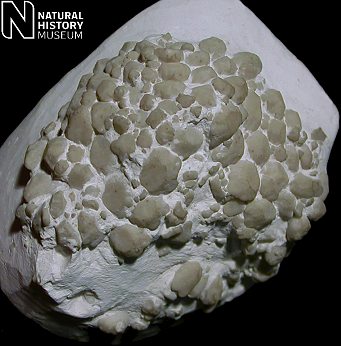
 A A |
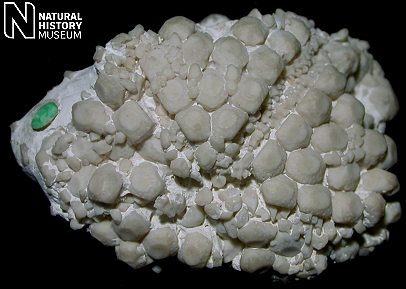 B B |
|
Valettaster ocellatus |
An unusual asteroid of the White Chalk, with a domed, cushion-shaped body. The ossicles are very distinctive; trapezoid in cross section, with fine, radiating ridges on the broad, flat apex of the upper surface and complex pits and furrows around the sloped sides. Articulated remains are scarce but isolated ossicles are common. Formerly known as Tholaster ocellatus. The similar Valettaster argus is smaller and its ossicles are generally less flattened and lacking the flat upper surface. On the whole, V. argus is close to how juvenile individuals of V. ocellatus might be expected to appear.
|
A |
B |
1). Aboral (A) and oral (B) views of two well preserved individuals; (A) x2.2, White chalk, BMNH (British Museum (Natural History) London) E2573; (B) x2.3, White Chalk, Marsupites testudinarius zone, from the beach near Roedean, just east of Brighton, Sussex, BMNH E5012. Images © 2005 The Natural History Museum, by kind permission.
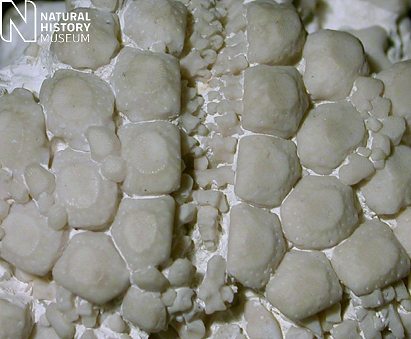
2). Detail of the above specimen (Fig 1A) showing the articulated ossicles of the oral surface and a well preserved ambulacral groove (x5.0). Image © 2005 The Natural History Museum, by kind permission.
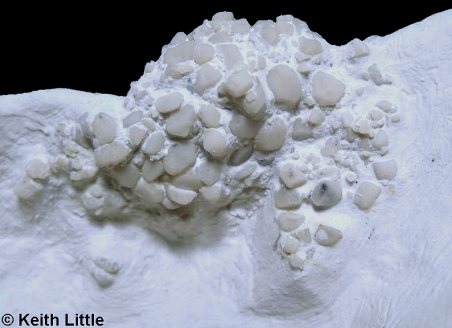 A A |
 B B |
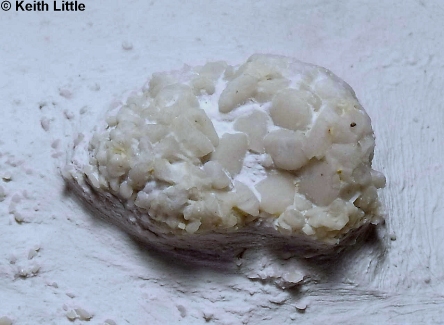
3). (A) Aboral view of a seemingly semi-articulated individual (x2.5, Seaford Chalk, Thanet Coast, Kent, in the collection of Keith Little); (B) A small specimen which may represent a semi-disarticulated juvenile(?) individual, or alternatively a pellet. (x4.0, Seaford Chalk, Thanet Coast, Kent, in the collection of Keith Little). Images © 2011 Keith Little, by kind permission.
 A A |
 B B |
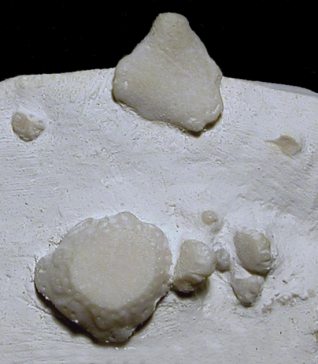
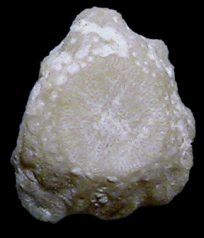
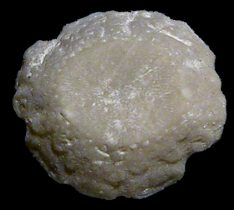 C C |
4). (A) Associated ossicles, or various size but the same form, note that the undersurface (ossicle top-centre) is smooth (x6.5, Culver Chalk Formation, Gaster's Pit 2, south of Lancing College, near Shoreham, West Sussex, Randell Collection, RR1156); (B, C) Typical ossicles, found associated in a dissected pellet (x6, Peacehaven, Newhaven Chalk Formation, both Randell Collection, RR1730).